
Important technical characteristics of 5G routers for industrial use
What technical features of 5G routers are important for industrial use?
What technical features of 5G routers are important for use in industry?
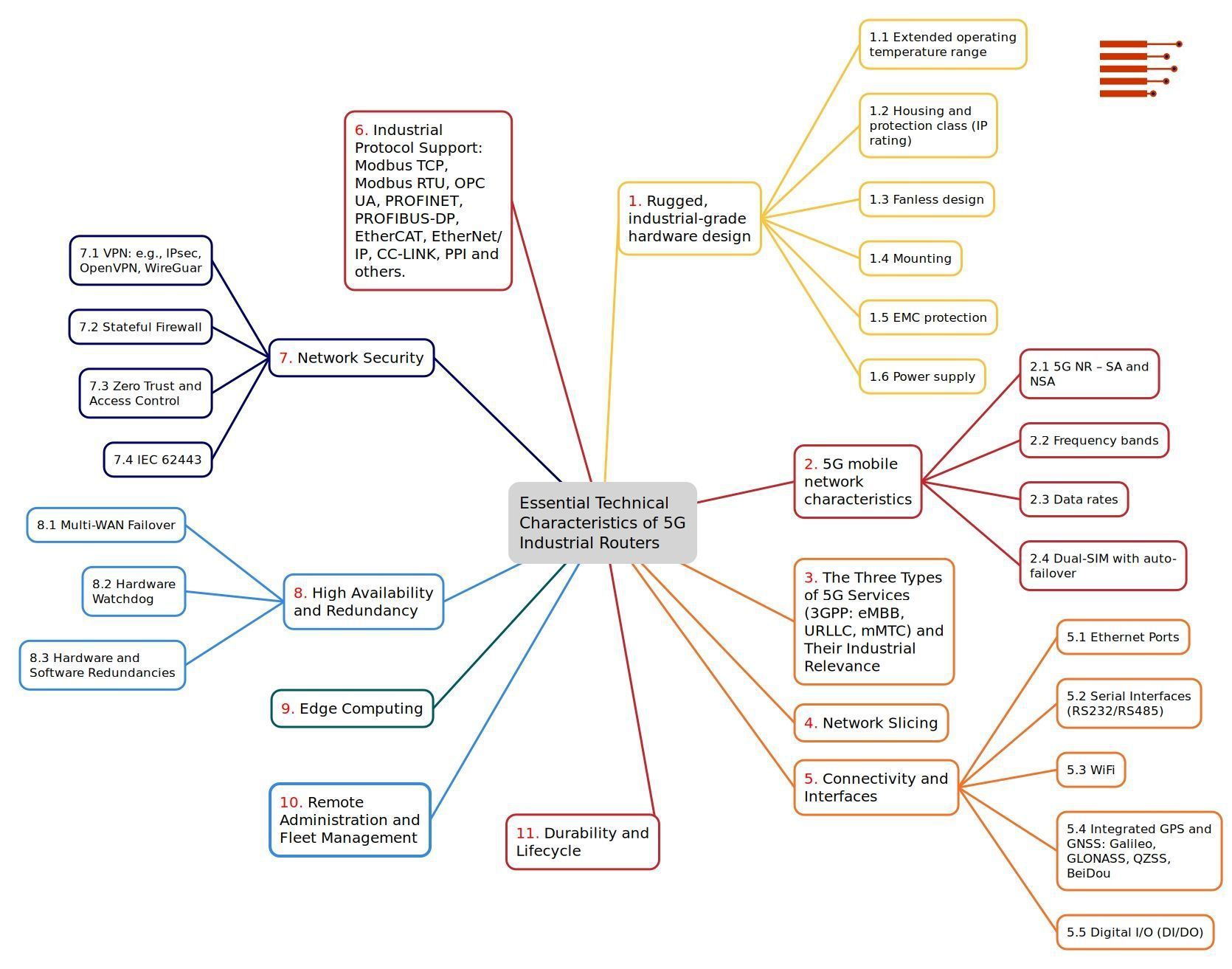
Ruggedness, 5G mobile characteristics, 3GPP standards, network slicing, connectivity and interfaces, network security, high availability and redundancy, remote management and fleet management, durability and lifecycle, wide temperature range.
Last updated: 3.09.2026
For 5G routers in industry, robust radio performance, high reliability, strong security features, and industrial environmental resilience are particularly important based on our experience. In the EU, depending on the area of application, several radio, security, and environmental requirementsmust must be met, especially regarding CE compliance, radio equipment regulations, cybersecurity, and product safety.
Necessary technical characteristics of 5G industrial routers
1. Robust, industrial-grade hardware design
1.1 Extended operating temperature range
For an industrial-grade router, an operating temperature range of -25 °C to +70 °C is required to ensure reliable operation in both deep-frozen outdoor cabinets and hot, poorly ventilated factory environments. Many devices even offer -40 °C to +70 °C with a wide input voltage range (e.g., 9-48 V DC).
1.2 Housing and protection class (IP rating)
An industrial-grade metal housing (e.g., aluminum) with at least IP30 is essential for protection against dust and physical impacts. For outdoor installations, weatherproof housings with IP65 or higher are used, including UV resistance for roof or field installations.
1.3 Fanless Design
A fanless design is ideal for dusty or explosion-prone environments where moving parts could fail or pose risks.
1.4 Mounting
DIN rail mounting allows for easy installation in control cabinets and industrial panels - typical for automation and SCADA systems. Additionally, wall and desktop mounting are supported.
1.5 EMC Protection
The router must have certified protection against electromagnetic interference (EMI), an important criterion in production.
1.6 Power Supply
Industrial models typically support a wide DC input voltage range (e.g., 9-36 V or 9-48 V DC) with reverse polarity protection. External surge protection devices on power and antenna lines protect against lightning or voltage spikes.
2. 5G Mobile Characteristics
2.1 5G NR - SA (Standalone) and NSA (Non-Standalone)
Unlike LTE, 5G does not use numbered categories. Instead, 5G capability is defined by 3GPP releases, deployment architecture (NSA (Non-Standalone) vs. SA (Standalone)), and usage profiles. Our recommendation: The router should support both SA and NSA and be backward compatible with 4G LTE (at least Cat 12, preferably Cat 19/20) to ensure maximum coverage.
Core Feature | Utilizes 5G radio access network (RAN) with existing 4G-LTE-Core | Standalone 5G Core Network |
Availability | Currently, the majority of 5G deployments; for many industrial IoT applications, there is still a strong reliance on LTE for stability and coverage. | Increasingly, especially for private campus networks |
URLLC/Slicing | Limited | Fully usable |
2.2 Frequency Bands
Different regions and operators support different 5G frequency bands. When purchasing a router, it must be ensured that the device supports the 5G bands of the respective region or operator.
- Sub-6 GHz (e.g., n77/n78 at 3.3-3.8 GHz): Industry standard for campus and public 5G networks in Europe
- mmWave (e.g., n258 at 24-28 GHz): Extremely high throughput but short range - for specific indoor scenarios
- 4G-LTE fallback bands: Extensive FDD and TDD band support
2.3 Data Rates
Industrial 5G routers achieve downlink speeds of up to 3.4 Gbps and uplink speeds of up to 1 Gbps in the sub-6 GHz range.
2.4 Dual-SIM with Auto-Failover
Dual-SIM failover is the "gold standard": The device accepts SIM cards from two different mobile network operators. Dual-SIM cards ensure link failover and provide connection stability, while also avoiding roaming costs. A combination of a regular SIM card and an eSIM offers even more flexibility.
3. The Three 5G Service Types (3GPP) and Their Industrial Relevance
The 3GPP standards define three primary use cases: eMBB, URLLC, and mMTC.
Service Type | Technical Goals | Industrial Application |
eMBB (Enhanced Mobile Broadband) | Uplink 50 Mbit/s to >1 Gbit/s, latency typically 10-20 ms | 4K/8K Video Surveillance, AR Maintenance, Digital Twins |
URLLC (Ultra-Reliable Low Latency) | Sub-Millisecond Air Interface Latency and 99.9999% Reliability (Six Nines) | Motion Control, Discrete Automation and Security Systems |
mMTC (Massive Machine-Type Communications) | Connection Density and Energy Efficiency instead of Speed; up to 1 Million Devices per km² | Environmental Sensors, Smart Meters, Asset Trackers |
For the industry, URLLC is the differentiator: URLLC guarantees 99.999% availability and latencies of up to 1 ms - comparable to wired connections and far better than Wi-Fi in interference-prone RF environments.
4. Network Slicing
A critical technological differentiator is Network Slicing: It allows a single physical 5G network to be partitioned into multiple virtual networks, each optimized for a specific application.
Example in Practice:
A router on a safety-critical robot can be assigned to a URLLC slice with guaranteed priority and low latency. At the same time, a router on a surveillance camera can be assigned to an eMBB slice for high video throughput. The isolation ensures that an increase in video traffic never affects the critical control signals of the robot.
5. Connectivity and Interfaces
5.1 Ethernet Ports
Gigabit Ethernet ports (typically 4-5 ports) enable high-speed cable connections. Multiple input/output interfaces allow for the connection of various devices - from cameras to PLCs.
5.2 Serial Interfaces (RS232/RS485)
Industrial 5G routers feature RS232 and RS485 interfaces for seamless integration of legacy devices and controls. They support Modbus RTU/ASCII, UDP/TCP client-server communication, and serial-to-Ethernet conversion to connect older devices with modern 5G and Ethernet networks.
5.3 WiFi
WiFi 6 enables 2.4 GHz and 5 GHz dual-band connections with download speeds of up to 1.8 Gbps.
5.4 GNSS / GPS
Integrated GPS and GNSS (Galileo, GLONASS, QZSS, BeiDou) enable real-time location tracking of remote assets.
5.5 Digital I/O (DI/DO)
Digital inputs and outputs (typically 1x DI, 1x DO) allow for the direct connection of simple sensors, relays, and alarms.
6. Industrial Protocol Support
For a wide range of applications in IoT, the router is compatible with common industrial real-time Ethernet and fieldbus protocols, including: Modbus TCP, Modbus RTU, OPC UA, PROFINET, PROFIBUS-DP, EtherCAT, EtherNet/IP, CC-LINK, PPI, and more.
Additionally, the router should support the following IT/IOT protocols:
UDP, TCP, Modbus, HTTPD, WebSocket, MQTT, and other protocols for converting serial devices.
7. Network Security
7.1 VPN
The device must support multiple robust VPN protocols (e.g., IPsec, OpenVPN, WireGuard) to create secure, encrypted tunnels for all traffic and protect it from eavesdropping.
7.2 Stateful Firewall
A powerful Stateful Firewall allows granular rules that precisely control which traffic is allowed in and out, thus preventing unauthorized access.
7.3 Zero Trust and Access Control
The security posture must shift from perimeter defense to a Zero Trust Architecture (ZTA). The router acts as a Policy Enforcement Point (PEP) and enforces strict Access Control Lists (ACLs) based on identity, not just IP address.
7.4 IEC 62443
Manufacturers that follow a secure development lifecycle according to IEC 62443 ensure that security is "built-in" and not added later.
8. High Availability and Redundancy
8.1 Multi-WAN-Failover
Automated failover/failback between Ethernet, cellular (dual-SIM), and WiFi ensures maximum availability.
8.2 Hardware Watchdog
Industrial 5G routers should provide monitoring functions for software operational disruptions. In the event of a critical failure such as an infinite loop, the device must automatically restart and immediately generate an error report.
8.3 Availability Targetarkeitsziel
Hardware and software redundancies - such as dual-SIM failover and proactive link management - guarantee 99.999% uptime.
9. Edge Computing
The most advanced industrial connectivity devices are more than just routers - they are powerful computers. The ability to process data locally at the network edge is a game changer: the router can analyze data from sensors or PLCs on-site and only send critical insights or alerts to the cloud. This reduces bandwidth costs, improves response times, and enhances data privacy.
Typical edge platform features:
Combination of 5G modem, powerful quad-core ARM processor (e.g., 1.6 GHz), and dedicated NPU (Neural Processing Unit) for hardware-accelerated AI.
Modern industrial 5G routers are sophisticated edge computing platforms that often utilize hardened Linux-based operating systems and can host Docker containers.
10. Remote management and fleet management
Cloud management saves significant costs by drastically reducing expensive on-site visits. Administrators can remotely monitor device status, diagnose issues, and roll out firmware or security updates to an entire fleet of routers from a central location, improving efficiency and uptime.
Typical features:
- Zero-Touch Provisioning (automatic commissioning)
- OTA firmware updates (Over-the-Air)
- Central dashboard for monitoring, alerting, configuration
11. Durability and lifecycle
Industrial routers are expected to operate continuously for 5-10 years under demanding conditions.
It is advisable to look for extended warranties (3-5 years) with renewal options.
12. Conclusion Checklist
Category | Must-have criteria |
Robustness | -40 °C to +70 °C, metal housing ≥ IP30 (Outdoor: ≥ IP65), fanless, DIN-Rail/wall, EMC protected |
5G mobile communication | SSA + NSA, Sub-6 GHz (+ possibly mmWave), 4G fallback ≥ Cat 12, Dual-SIM with auto-failover |
Latency & reliability | URLLC capable (< 1 ms latency, ≥ 99.999 % availability), Network Slicing Support |
Interfaces | ≥ 4x Gigabit Ethernet, RS232/RS485, DI/DO, WiFi 5/6, GNSS/GPS |
Industrial Protocols | Modbus TCP/RTU, OPC UA, MQTT; possibly PROFINET, EtherNet/IP, EtherCAT |
Security | IPsec/OpenVPN/WireGuard VPN, Stateful Firewall, ACL, Zero-Trust capable, IEC 62443 |
Availability | Multi-WAN-Failover (Cellular/Ethernet/WiFi), Hardware Watchdog, Auto-Recovery |
Edge Computing | Multi-core ARM CPU, ≥ 1 GB RAM, Docker/container capable, Python/Node-RED |
Management | Cloud platform, Zero-Touch Provisioning, OTA Updates, central monitoring |
Power Supply | Further DC range (9-48 V), reverse polarity protection, ext. surge protection |
Lifecycle | ≥ 5 years availability, ≥ 3 years warranty, long-term firmware support |
Technical Specifications of the Robustel 5G Router
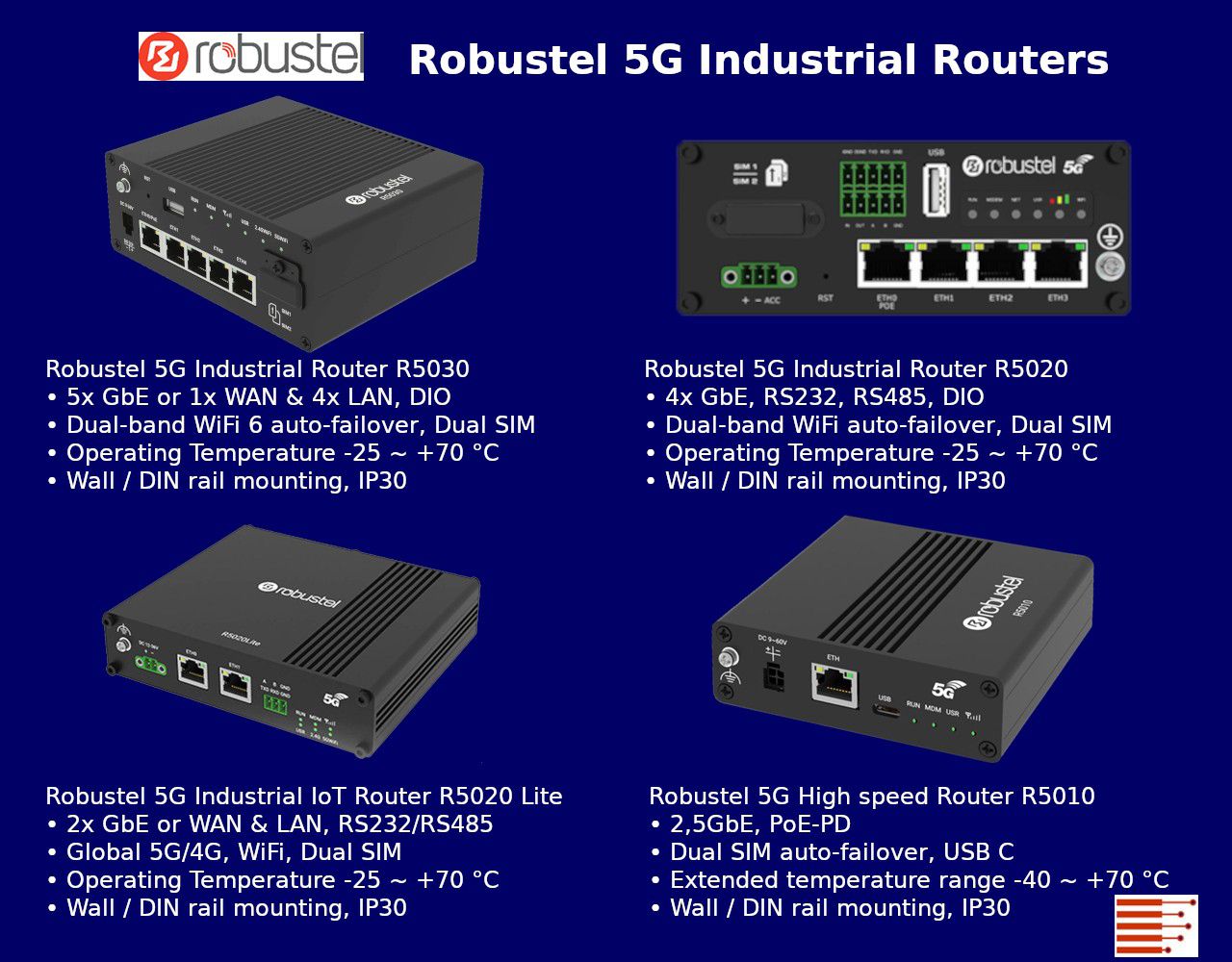
Robustel 5G Industrial Routers R5020, R5010, R5030, R5020 Lite
Get informed and equip your business with efficient 5G connectivity.
Consult your expert: Sven Trommer, Tel. +49407003550
We look forward to hearing from you!
Jelena Dronowa, Head of Digital Media, Dipl.-Ing in Systems Engineering
